CIE Mathematics past papers are an invaluable resource for students preparing for their exams. They offer a realistic glimpse into the exam format, question types, and the level of difficulty students can expect. By diligently working through these past papers, students can identify their strengths and weaknesses, pinpoint areas where they need further study, and gain confidence in their abilities. Practicing with past papers also helps students develop crucial exam techniques such as time management, identifying key information, and presenting their solutions clearly and concisely.
Furthermore, past papers provide valuable insights into the specific areas of the syllabus that are frequently tested. This allows students to focus their revision efforts effectively, ensuring they are well-prepared for the most important topics. By analyzing the mark schemes provided with the past papers, students can understand the criteria used by examiners to award marks, allowing them to improve the quality of their answers and maximize their potential.
In conclusion, CIE Mathematics past papers are an indispensable tool for any student aiming to achieve success in their exams. By utilizing these resources effectively, students can enhance their understanding of mathematical concepts, develop essential exam skills, and significantly improve their overall performance.
Reflect on the subjects you enjoy the most and excel in. Your passion for a subject can enhance your learning experience and motivate you to perform better.
3. Future Aspirations IGCSE path
Think about your long-term goals and how your IGCSE subjects align with them. Research the prerequisites for the courses or careers you are considering, as some may require specific subjects.
Assess your strengths and weaknesses in various subjects. Choose subjects where you feel confident but also consider challenging yourself in areas that interest you.
5. Seek Advice
Consult with teachers, school counselors, or older students who have already gone through the IGCSE process. They can provide valuable insights and advice based on their experiences.
6. Balance Your Load
Try to strike a balance between core subjects needed for higher education and subjects that reflect your personal interests. Avoid overloading yourself with too many subjects at once.
7. Plan for Further Education
If you intend to pursue A-levels or equivalent courses, check which IGCSE subjects are recommended for those pathways. Schools often have specific subject requirements for advanced studies.
8. Keep it Flexible
Remember that your interests and career goals may evolve over time. Choose subjects that offer flexibility and allow you to explore different fields.
Conclusion
Take your time to research and meditate on your choices. Making a well-rounded decision can set a solid foundation for your future academic and career paths.
Mathematics Extended for IGCSE students often carries a mix of excitement and apprehension. For some, it represents an opportunity to excel and dive deep into the fascinating world of numbers. For others, it may seem like a challenge that requires extra effort. However, with the right approach and tools, Math Extended can be conquered effectively.
Understanding the IGCSE Math Extended Curriculum
The IGCSE Math Extended syllabus goes beyond the basics, introducing students to advanced topics such as quadratic equations, trigonometry, and probability. It is designed for students aiming for grades A* to C and provides a solid foundation for further studies in mathematics and related fields.
While the topics may appear challenging initially, they are structured to ensure a comprehensive understanding. Resources like the Cambridge IGCSE Mathematics Syllabus offer detailed outlines of the curriculum.
Why Is Math Extended Considered Tough?
Advanced Concepts Extended math introduces topics that demand higher-order thinking. For instance, mastering calculus and advanced geometry requires practice and dedication.
Time Management Balancing mathematics with other IGCSE subjects can feel overwhelming. Assignments, mock exams, and revisions demand excellent organizational skills.
Problem-Solving Focus The emphasis on solving complex problems can be daunting for students unfamiliar with analytical thinking.
Transforming Challenges into Opportunities
Despite its difficulties, Math Extended offers several benefits:
Developing Critical Thinking Skills Topics like algebra and trigonometry encourage students to think logically and solve problems systematically.
Preparation for Advanced Studies Success in IGCSE Math Extended equips students for higher-level mathematics in A-Levels or IB programs.
Real-World Applications Many professions, from engineering to finance, rely heavily on mathematical principles taught in Math Extended.
Practice Regularly Solving past papers is a proven way to prepare effectively. Websites like Save My Exams provide access to a wide range of practice materials.
Understand the Concepts Memorizing formulas isn’t enough. Understanding their derivation and application is crucial.
Use Technology to Your Advantage Tools like Cymath simplify complex calculations and help with step-by-step problem-solving.
Seek Help When Needed Joining study groups or hiring a tutor can clarify doubts and strengthen weak areas.
Stay Positive and Persistent Motivation plays a vital role in success. Celebrate small achievements and learn from mistakes.
Common Mistakes to Avoid
Skipping Steps In exams, skipping calculation steps can lead to errors. Show your work for better clarity and potential partial credit.
Neglecting Weak Topics Ignoring challenging topics like calculus or functions can affect overall performance. Dedicate extra time to these areas.
Overloading Study Time Overworking can lead to burnout. Balance study sessions with relaxation and recreational activities.
The Role of Parents and Teachers
Parents and teachers play an essential role in motivating and guiding students. Encouraging a growth mindset and providing constructive feedback can boost confidence.
Teachers can further support students by offering tailored feedback on assignments and creating a positive learning environment.
Conclusion
IGCSE Math Extended might seem challenging, but with determination and the right strategies, it transforms into an opportunity for academic and personal growth. Embrace the journey, use available resources, and believe in your ability to succeed.
Math Extended is an integral part of the IGCSE syllabus.Students often wonder, “Is Math Extended tough or manageable?”To excel in Math Extended, understanding the curriculum is crucial.Practice is essential for mastering Math Extended.Advanced topics in Math Extended can feel overwhelming.Math Extended builds a strong foundation for higher education.Many students enjoy the challenges of Math Extended.Problem-solving skills improve through Math Extended.Explore resources to succeed in Math Extended.Teachers often provide tips for excelling in Math Extended.
Mathematics can be challenging, and every student knows that solving complex equations sometimes requires extra support. Cymath 2024 (https://www.cymath.com/) is a highly effective online math-solving tool, designed to assist students from various educational backgrounds in breaking down and understanding difficult math problems. This article will guide you through Cymath’s features and show you how it can be a valuable companion for any math student on their journey to mastering concepts.
Cymath 2024 is a powerful tool for students tackling complex math problems, making it an ideal resource to feature on home.notonlybook.com/. This app provides step-by-step solutions for a variety of topics, including algebra, calculus, and basic arithmetic, all by simply inputting equations or taking photos of written problems. Cymath uses advanced AI to break down each solution into clear, understandable steps, which is especially helpful for students preparing for exams or homework. By integrating Cymath into their study routines, students can boost their understanding and confidence in solving challenging problems independently. For home.notonlybook.com/, this resource aligns well with helping students achieve better results Cymath.
What Is Cymath?
Cymath 2024 is an online math problem-solving tool that covers a wide range of mathematical topics, from algebra and calculus to statistics and trigonometry. The platform is accessible both online and via mobile apps, making it easy for students to get math help anytime, anywhere. By inputting a math problem into Cymath, students receive a step-by-step solution that guides them through the logic and processes required to arrive at the correct answer Cymath.
How Cymath Helps Students Master Math
1. Step-by-Step Solutions
One of Cymath 2024 biggest advantages is its clear, step-by-step explanations. Unlike traditional calculators that only provide an answer, Cymath shows every stage of the solution process, making it an ideal study tool. Students can follow along with the steps to understand where they might have gone wrong and gain insights into effective problem-solving techniques.
Algebra: Simplification, factoring, and solving equations
Calculus: Differentiation and integration
Statistics and Probability: Basic concepts like mean, median, and mode
Trigonometry: Functions, identities, and solving triangles Cymath
This breadth makes Cymath a versatile tool for students of various grade levels and mathematical needs, from middle school up to college-level math.
3. Visual Interface and User-Friendly Design
The user-friendly design makes it straightforward for students to input complex equations and see a structured breakdown of the solution. Cymath’s mobile app interface is equally intuitive, offering the convenience of math support right from a smartphone. This feature is especially helpful for students who prefer a hands-on approach to learning.
4. Free and Premium Versions
Cymath 2024 offers a free version with core features that provide ample support for most math problems. For those seeking a more in-depth experience, Cymath Premium offers additional resources, including explanations of certain solution steps and ads-free browsing. This flexibility allows students to choose the version that best suits their needs and budget.
5. Helpful for Homework and Exam Preparation Cymath
By offering a deeper understanding of math problems, Cymath is a great aid for homework completion and exam preparation. Students can use it to review concepts and practice problem-solving, building confidence in their abilities over time. The practice-oriented approach helps reinforce learning and solidify understanding of key topics Cymath.
Using Cymath on home.notonlybook.com/
On home.notonlybook.com/, we understand the importance of accessible resources that enhance student learning. Integrating tools like Cymath 2024 into your study routine is a great way to complement the IGCSE and other resources available on our platform. While NotOnlyBook provides textbooks, past papers, and educational articles, Cymath adds an interactive component that helps students directly engage with and solve math problems.
How to Get Started with Cymath
Visit the Website or Download the App: Go to https://www.cymath.com or download the app from your device’s app store.
Input Your Problem: Type in a math problem, or use the app’s camera feature to scan a handwritten equation.
View the Solution Steps: Follow the detailed steps provided to understand the solution path and learn the reasoning behind each step.
Practice Regularly: Use Cymath regularly to practice various topics, strengthen your skills, and improve your math confidence.
Why Every Student Should Try Cymath
Whether you’re struggling with a difficult problem or just want to double-check your work, Cymath is an invaluable resource for students of all levels. Its accessibility, clear explanations, and range of topics make it an essential tool for students, parents, and tutors alike. For NotOnlyBook users, Cymath is the perfect supplement to our collection of educational materials, empowering students to take control of their math journey Cymath 2024.
Conclusion
Cymath stands out as an excellent support tool for students aiming to improve their math skills. By using Cymath alongside the resources at home.notonlybook.com/, students can gain a comprehensive understanding of math topics, enhance their study sessions, and tackle math with confidence. Whether you’re prepping for exams or seeking help with daily homework, Cymath is here to make math more manageable and enjoyable. Cymath 2024
This draft highlights Cymath’s functionality, benefits, and the ease with which students can incorporate it into their math studies on home.notonlybook.com/. Let me know if you need images or additional edits.
A-Level Mathematics is a crucial subject for students pursuing advanced studies in various scientific and engineering fields. The A-Level Mathematics P-1 Topical Past Paper provides students with the perfect blend of practice and exam preparation, focusing on frequently tested areas. This article delves into the importance of Paper 1 in A-Level Mathematics, offers insights on its contents, and includes a free download link to the topical past paper collection.
The Importance of A-Level Mathematics Paper 1
A-Level Mathematics is a demanding course that builds upon foundational knowledge from previous levels, introducing students to more advanced concepts such as calculus, trigonometry, and algebra. Paper 1 (P1) is a key component in the A-Level syllabus, covering the following areas:
Algebra and Functions – Mastering polynomial functions, quadratic equations, and inequalities.
Coordinate Geometry – Covering straight lines, circles, and their equations.
Trigonometry – Focusing on trigonometric identities, functions, and equations.
Differentiation and Integration – Introduction to calculus, including derivatives, integrals, and applications.
Sequences and Series – Understanding arithmetic and geometric sequences and series.
P1 establishes core mathematical concepts that are vital for more advanced modules like P3 and P4 and essential for students moving into technical degree programs.
What’s Inside the A-Level Mathematics P-1 Topical Past Paper Collection?
The A-Level Mathematics P-1 Topical Past Paper Collection organizes exam questions by topic, helping students focus on areas needing improvement. This approach is beneficial because it allows students to:
Target Weak Areas – With topic-specific past paper questions, students can focus on challenging topics and improve their understanding gradually.
Identify Exam Trends – By reviewing past questions, students can familiarize themselves with frequently tested topics, question types, and marking schemes.
Practice Under Exam Conditions – Working through these papers under timed conditions improves exam performance and confidence.
Key Topics in the A-Level Mathematics P-1 Topical Past Paper
1. Algebra and Functions
Topics such as factorization, solving inequalities, and transformations of functions form the foundation of Paper 1. Mastering these concepts helps students tackle more complex algebraic equations in higher-level papers.
2. Coordinate Geometry
Essential for understanding spatial relationships, coordinate geometry is critical for applications in physics and engineering. Topics include the equation of lines and circles, midpoint and distance calculations, and more complex geometric proofs.
3. Trigonometry
From trigonometric identities to solving equations, trigonometry has real-world applications in fields like physics, engineering, and computer science. The past papers cover important concepts like the sine and cosine rules, angle transformations, and inverse trigonometric functions.
4. Calculus (Differentiation and Integration)
Calculus is central to understanding changes in quantities, rates, and accumulations, and it has significant applications in economics, biology, and physical sciences. Topics in P1 include finding derivatives, solving problems involving maximum and minimum values, and basic integration.
5. Sequences and Series
Sequences and series are foundational for understanding progressions and growth patterns, with applications in finance and computing. Topics include arithmetic and geometric sequences, the nth term formula, and summation of series.
Benefits of the Topical Past Paper Approach
The A-Level Mathematics P-1 Topical Past Paper Collection is ideal for students who want to study smarter, not harder. Here’s how using this resource can benefit your study routine:
Topic-Focused Revision – Allows you to study one topic at a time, reinforcing concepts before moving on to the next.
Exam Familiarity – Practicing with actual exam questions helps students get accustomed to the types of questions they’ll encounter.
Self-Evaluation – The past paper answers provide a way for students to check their work and understand how examiners allocate marks, highlighting areas for improvement.
Time Management Skills – Attempting these questions within set time limits mirrors the pressures of real exams, helping students develop effective time management.
Download the A-Level Mathematics P-1 Topical Past Paper Collection for Free!
For additional study materials, visit Not Only Book, where you can find resources, tips, and past papers for A-Level and IGCSE students.
Study Tips for A-Level Mathematics Paper 1
Understand the Concepts:
Paper 1 topics are foundational for other A-Level papers, so ensure you fully understand each concept. Avoid relying solely on memorization; instead, focus on why each formula or rule works.
Create a Revision Schedule:
Set a study schedule that covers each topic adequately. Review challenging areas multiple times until they become familiar.
Practice Regularly:
Practicing regularly is essential for improving accuracy and speed. Make use of past papers and take note of areas where you lose marks.
Use Graphs and Visual Aids:
Graphs are helpful for understanding functions, geometry, and calculus. Drawing them out can make complex problems easier to grasp.
Master Calculus Basics Early On:
Calculus is introduced in P1, and it becomes more complex in later papers. Start by mastering basic differentiation and integration concepts to build a strong foundation.
Review Mistakes:
Carefully review errors in past papers to ensure you don’t repeat them. Look at the marking schemes to understand how to improve your answers.
Additional Resources for Success
For further support, consider exploring these resources:
1. How do I best prepare for A-Level Mathematics Paper 1?
Focus on understanding key concepts and practice consistently using topical past papers. Doing timed practice papers is crucial for improving speed and accuracy.
2. How difficult is A-Level Mathematics compared to IGCSE?
A-Level Mathematics is more advanced and requires a strong understanding of concepts from IGCSE Mathematics. Regular practice and using resources like topical past papers can help manage the increased difficulty.
3. Are calculators allowed in Paper 1?
Calculator policies vary depending on the exam board, so always check the specific guidelines. If calculators are allowed, practice using them efficiently during exam preparation.
Conclusion
The A-Level Mathematics P-1 Topical Past Paper Collection is an indispensable tool for students aiming to achieve high marks in their exams. By focusing on each topic individually, you can develop a solid understanding of essential concepts and improve your problem-solving skills. With dedicated practice and a clear study plan, success in A-Level Mathematics is well within reach.
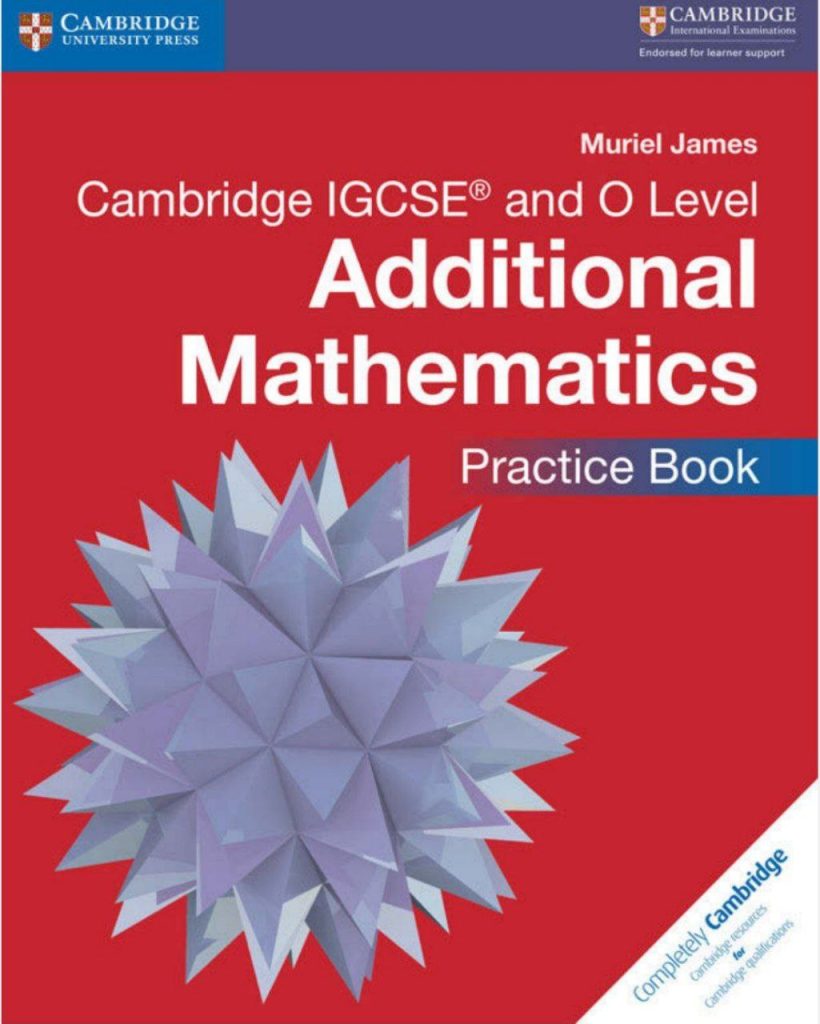
his article dives into the Cambridge IGCSE® and O Level Additional Mathematics Practice Book, a vital resource for students aiming to excel in advanced math topics covered in IGCSE syllabuses. It’s designed to reinforce core concepts with comprehensive exercises, supporting students in mastering challenging areas such as functions, trigonometry, and calculus.
Key Topics Covered
The book begins with foundational topics like sets and functions, progressing to more complex areas including:
Quadratic Equations and Inequalities
Logarithmic and Exponential Functions
Circular Measure
Differentiation and Integration
Each chapter includes objectives, worked examples, and exam-style questions to consolidate understanding.
Additional Mathematics Download the Book for Free!
Access the book now and deepen your mathematical understanding.
Mathematics is often seen as a challenging subject, especially at higher levels like the Cambridge IGCSE Additional Mathematics. This subject is pivotal for students who want to excel in fields that require strong analytical and mathematical skills, such as engineering, physics, and computer science. The Cambridge IGCSE Additional Mathematics Practice Book is a comprehensive resource designed to support students in mastering the subject. This article explores its key contents, learning benefits, and offers a free download link to the practice book.
Cambridge IGCSE Additional Mathematics (syllabuses 0606 and 4037) is an advanced course aimed at students who have already gained a strong understanding of basic mathematics. This course is rigorous and covers topics that lay the groundwork for further studies in calculus, trigonometry, and complex functions, which are foundational in many STEM (Science, Technology, Engineering, and Mathematics) fields.
The topics in Additional Mathematics challenge students with higher-level mathematical concepts and problem-solving strategies. Through this course, students develop:
Analytical skills: Dealing with complex equations, trigonometric functions, and calculus teaches students to approach problems analytically.
Logical reasoning: Many topics, like vectors and matrices, require logical thinking, which is beneficial across various fields.
Mathematical application skills: Practical applications of functions, calculus, and other areas are emphasized, which prepares students for real-world applications of math.
Key Contents of the Cambridge IGCSE Additional Mathematics Practice Book
The Cambridge IGCSE Additional Mathematics Practice Book is structured to align closely with the Cambridge syllabus. Each chapter begins with clearly outlined objectives, provides worked examples, and concludes with exam-style questions, enabling students to reinforce their understanding through continuous practice. Here’s an overview of some of the main topics covered in this book:
Functions and Relations:
Understanding and working with functions is foundational for advanced mathematics. Topics include one-one functions, inverse functions, and composite functions.
Students learn how to map various equations and analyze relationships between variables.
Quadratics and Polynomials:
This section delves into solving quadratic equations, understanding inequalities, and working with polynomial expressions. Quadratic functions are not only crucial in mathematics but also in physics, economics, and engineering.
Logarithmic and Exponential Functions:
Logarithmic and exponential functions have practical applications in science and finance. This book guides students through solving equations involving logarithms and exponentials, which are essential for understanding growth patterns, decay processes, and more.
Differentiation and Integration (Calculus):
Calculus is a critical tool for solving problems involving change, motion, and area under curves. Topics in differentiation include the gradient function, the product rule, and the chain rule, while integration covers indefinite and definite integrals and applications of integration.
Vectors and Matrices:
Vectors and matrices are powerful tools in physics and computer graphics. This section explores vector geometry, constant velocity problems, and matrix transformations.
Permutations and Combinations:
Probability theory and combinatorics are key areas in statistics and computer science. This book covers factorial notation, permutations, and combinations, which are foundational for understanding probability and arrangements.
Trigonometry:
Advanced trigonometry, including the general definition of an angle, trigonometric identities, and graphs of trigonometric functions, are explored. Trigonometry plays a significant role in fields requiring spatial understanding, such as architecture and engineering.
Learning Benefits of the Practice Book
The Cambridge IGCSE Additional Mathematics Practice Book is designed not only to teach but to reinforce learning. Each chapter includes:
Worked Examples: Step-by-step examples are provided to help students understand how to solve different types of problems, giving them a framework to tackle similar problems on their own.
Graded Exercises: Starting with simpler problems, the exercises progress to more challenging questions, encouraging students to build confidence in each topic.
Exam-Style Questions: The end-of-chapter questions simulate actual exam questions, preparing students for their final exams.
Answers and Explanations: Complete answers to each exercise and exam-style question are provided, allowing students to self-assess their understanding.
These features make the book suitable for self-study, empowering students to work independently and at their own pace. For students who require additional guidance, this book serves as an excellent supplement to teacher-led instruction, offering further practice and reinforcing concepts introduced in the classroom.
Study Tips for Cambridge IGCSE Additional Mathematics
Master the Basics First:
Before diving into complex topics like calculus or trigonometry, ensure you have a solid understanding of algebra, functions, and quadratic equations. These fundamentals are often prerequisites for more advanced topics.
Practice Consistently:
Mathematics is a skill that improves with practice. Set aside regular study sessions and work through problems consistently to build confidence and familiarity with each topic.
Understand the Logic Behind the Math:
Instead of just memorizing formulas, try to understand the reasoning and logic behind them. For instance, understanding why the chain rule works in differentiation can help you apply it more effectively.
Use Graphs and Diagrams:
Graphs can make complex problems more understandable, especially in topics like trigonometry and calculus. Visualizing problems often helps in grasping concepts more intuitively.
Focus on Exam-Style Questions:
Regularly practicing exam-style questions will help you become familiar with the format and timing of the actual exam. This practice can reduce anxiety and improve your performance.
Download the Cambridge IGCSE Additional Mathematics Practice Book for Free!
For more IGCSE study materials, check out our dedicated resources page on Not Only Book, where you can find additional materials, past papers, and study tips to excel in IGCSE exams.
External Resources to Support Your Learning
In addition to this practice book, here are some other excellent resources:
Wolfram Alpha – A powerful computational tool that helps solve and visualize complex equations.
Frequently Asked Questions
1. Is Cambridge IGCSE Additional Mathematics required for A-Level Math?
While it’s not mandatory, studying Additional Mathematics at the IGCSE level can significantly benefit students moving on to A-Level Mathematics, as it provides foundational knowledge for advanced topics like calculus and algebra.
2. How difficult is Cambridge IGCSE Additional Mathematics?
This course is challenging and is intended for students who have a strong grasp of basic mathematics. With consistent practice and the right resources, however, students can excel.
3. Can I study Additional Mathematics on my own?
Yes, with resources like the Cambridge IGCSE Additional Mathematics Practice Book and access to online tutorials, self-study is a viable option. However, having support from a teacher or tutor can be helpful, especially for difficult topics.
Final Thoughts
The Cambridge IGCSE Additional Mathematics Practice Book is an invaluable tool for any student looking to achieve excellence in mathematics. Its structured, comprehensive approach ensures that students not only understand each topic but also develop the skills to apply their knowledge effectively. Mathematics, while challenging, is a subject that opens doors to countless opportunities, and mastering it can be an incredibly rewarding experience.