Tag: educational diagrams

  • IGCSE Mathematics: Mastering Quadratic Equations

    IGCSE Mathematics: Mastering Quadratic Equations

    Quadratic equations are a fundamental topic in IGCSE Mathematics. Understanding how to solve and apply them is essential for success in various areas of math and real-world problem-solving. In this article, we’ll explore the basic form of quadratic equations, methods of solving them, and how they can be applied to everyday problems.

    Quadratic Equations

    What is a Quadratic Equation?

    A quadratic equation is a polynomial equation of the form:ax2+bx+c=0ax^2 + bx + c = 0ax2+bx+c=0
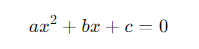
    where aaa, bbb, and ccc are constants, and xxx represents an unknown variable. The highest degree (or exponent) of xxx is 2, which defines it as a quadratic equation.

    • If a=0a = 0a=0, the equation becomes linear.
    • If a≠0a \neq 0a=0, the equation forms a parabola when graphed.

    Solving Quadratic Equations

    There are several methods to solve quadratic equations, each with its advantages depending on the specific equation.

    1. Factoring: Factoring is one of the simplest methods, but it only works for certain equations. You rewrite the quadratic equation in a factorized form:ax2+bx+c=(mx+n)(px+q)=0ax^2 + bx + c = (mx + n)(px + q) = 0ax2+bx+c=(mx+n)(px+q)=0To solve the equation, set each factor to zero and solve for xxx:(mx+n)=0or(px+q)=0(mx + n) = 0 \quad \text{or} \quad (px + q) = 0(mx+n)=0or(px+q)=0Example:x2−5x+6=0⇒(x−2)(x−3)=0x^2 – 5x + 6 = 0 \quad \Rightarrow \quad (x – 2)(x – 3) = 0x2−5x+6=0⇒(x−2)(x−3)=0The solutions are x=2x = 2x=2 and x=3x = 3x=3.
    1. Factoring Quadratics – Khan Academy
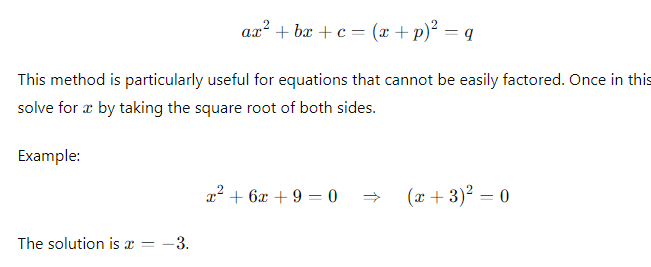
    2. Completing the Square: Completing the square is a method that transforms the quadratic equation into a perfect square trinomial:ax2+bx+c=(x+p)2=qax^2 + bx + c = (x + p)^2 = qax2+bx+c=(x+p)2=qThis method is particularly useful for equations that cannot be easily factored. Once in this form, solve for xxx by taking the square root of both sides.Example:x2+6x+9=0⇒(x+3)2=0x^2 + 6x + 9 = 0 \quad \Rightarrow \quad (x + 3)^2 = 0x2+6x+9=0⇒(x+3)2=0The solution is x=−3x = -3x=−3.
    Completing the Square – Math Is Fun

    1. Quadratic Formula: The quadratic formula is a universal method that works for any quadratic equation:x=−b±b2−4ac2ax = \frac{-b \pm \sqrt{b^2 – 4ac}}{2a}x=2a−b±b2−4ac​​Here, the discriminant (b2−4acb^2 – 4acb2−4ac) determines the nature of the solutions:
      • If b2−4ac>0b^2 – 4ac > 0b2−4ac>0, there are two real solutions.If b2−4ac=0b^2 – 4ac = 0b2−4ac=0, there is one real solution.If b2−4ac<0b^2 – 4ac < 0b2−4ac<0, there are two complex (imaginary) solutions.
      Example:2×2+3x−2=0⇒x=−3±32−4(2)(−2)2(2)2x^2 + 3x – 2 = 0 \quad \Rightarrow \quad x = \frac{-3 \pm \sqrt{3^2 – 4(2)(-2)}}{2(2)}2×2+3x−2=0⇒x=2(2)−3±32−4(2)(−2)​​The solutions are x=−3+254=0.5x = \frac{-3 + \sqrt{25}}{4} = 0.5x=4−3+25​​=0.5 and x=−3−254=−2x = \frac{-3 – \sqrt{25}}{4} = -2x=4−3−25​​=−2.
    1. Quadratic Formula – BBC Bitesize

    The Discriminant

    The discriminant (b2−4acb^2 – 4acb2−4ac) is an important part of the quadratic formula because it tells you how many solutions the equation has, and whether those solutions are real or complex.

    1. Understanding the Discriminant – Varsity Tutors

    Graphing Quadratic Equations

    Quadratic equations are often represented graphically as parabolas. The general shape of a parabola depends on the value of aaa:

    • If a>0a > 0a>0, the parabola opens upwards (U-shaped).
    • If a<0a < 0a<0, the parabola opens downwards (inverted U-shaped).

    Key features of a parabola include:

    • Vertex: The highest or lowest point on the graph.
    • Axis of Symmetry: The vertical line that passes through the vertex.
    • Roots or x-intercepts: The points where the parabola intersects the x-axis (i.e., the solutions of the equation).

    The vertex of a parabola can be found using the formula:xvertex=−b2ax_{\text{vertex}} = \frac{-b}{2a}xvertex​=2a−b​

    Applications of Quadratic Equations

    Quadratic equations are used in a variety of real-world scenarios:

    1. Projectile Motion: The path of a projectile (like a ball being thrown) follows a quadratic equation, where the height of the object is a function of time. Example: The equation h(t)=−4.9t2+vt+h0h(t) = -4.9t^2 + vt + h_0h(t)=−4.9t2+vt+h0​ describes the height of a projectile in terms of time ttt, initial velocity vvv, and initial height h0h_0h0​.
    2. Optimization Problems: Quadratic equations are often used to find maximum or minimum values in optimization problems, such as finding the best price to sell a product or determining the maximum area for a given perimeter.
    3. Area Calculations: Quadratics can be used to calculate areas of geometric shapes when they involve squared dimensions.

    Conclusion

    Quadratic equations are a critical component of IGCSE Mathematics. Mastering the different methods of solving quadratics, understanding the discriminant, and learning how to apply them in real-life situations will help you succeed in math and beyond. Whether through factoring, completing the square, or using the quadratic formula, you’ll have the tools you need to solve any quadratic equation with confidence.

  • Mathematics: Understanding Trigonometry

    Mathematics: Understanding Trigonometry

    Understanding Trigonometry

    Understanding Trigonometry

    Mathematics: Understanding Trigonometry is a crucial topic in the IGCSE Mathematics syllabus that deals with the
    relationships between angles and sides of triangles, particularly right-angled triangles. These relationships form the foundation for understanding various real-world problems, including navigation, architecture, and engineering. In this article, we will cover the basics of trigonometry, including trigonometric ratios, solving triangles, and applying trigonometry to real-life situations.

    What is Trigonometry?

    Trigonometry is the branch of mathematics that studies the relationships between the angles and lengths of triangles. Specifically, it focuses on right-angled triangles, where one angle is 90∘90^\circ90∘. In trigonometry, we explore how the angles of a triangle relate to the lengths of the sides.

    The three main trigonometric functions, or ratios, are:

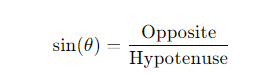
    • Sine (sin): The ratio of the opposite side to the hypotenuse.
    • Cosine (cos): The ratio of the adjacent side to the hypotenuse.
    • Tangent (tan): The ratio of the opposite side to the adjacent side.

    These ratios allow us to solve for unknown sides or angles in right-angled triangles when some information is already known.

    Trigonometric Ratios

    Mathematics: Understanding Trigonometry

    The three basic trigonometric ratios are fundamental in solving problems related to triangles. Here is how they are defined for a right-angled triangle:

    1. Sine:sin⁡(θ)=OppositeHypotenuse\sin(\theta) = \frac{\text{Opposite}}{\text{Hypotenuse}}sin(θ)=HypotenuseOpposite​The sine of an angle is the ratio between the length of the side opposite the angle and the hypotenuse.
    1. Cosine:cos⁡(θ)=AdjacentHypotenuse\cos(\theta) = \frac{\text{Adjacent}}{\text{Hypotenuse}}cos(θ)=HypotenuseAdjacent​The cosine of an angle is the ratio of the length of the adjacent side to the hypotenuse.
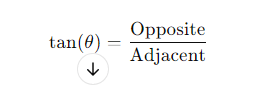
    1. Tangent:tan⁡(θ)=OppositeAdjacent\tan(\theta) = \frac{\text{Opposite}}{\text{Adjacent}}tan(θ)=AdjacentOpposite​The tangent of an angle is the ratio between the side opposite the angle and the side adjacent to it.

    Solving Right-Angled Triangles

    Trigonometry is often used to solve right-angled triangles, where you may be required to find a missing side or angle.

    1. Finding a Side: Suppose you know one angle (other than the right angle) and one side of a right-angled triangle. You can use one of the trigonometric ratios to find a missing side. For example, if you know the angle θ\thetaθ and the length of the hypotenuse, you can find the opposite side using:sin⁡(θ)=OppositeHypotenuse⇒Opposite=sin⁡(θ)×Hypotenuse\sin(\theta) = \frac{\text{Opposite}}{\text{Hypotenuse}} \quad \Rightarrow \quad \text{Opposite} = \sin(\theta) \times \text{Hypotenuse}sin(θ)=HypotenuseOpposite​⇒Opposite=sin(θ)×Hypotenuse
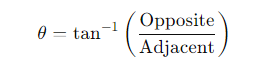
    1. Finding an Angle: To find an unknown angle, you can use the inverse of the trigonometric ratios. For instance, if you know the opposite and adjacent sides, you can find the angle θ\thetaθ using:θ=tan⁡−1(OppositeAdjacent)\theta = \tan^{-1} \left( \frac{\text{Opposite}}{\text{Adjacent}} \right)θ=tan−1(AdjacentOpposite​)
    1. Pythagoras’ Theorem: Another useful tool when solving triangles is Pythagoras’ Theorem, which states that in a right-angled triangle:a2+b2=c2a^2 + b^2 = c^2a2+b2=c2where aaa and bbb are the lengths of the two legs, and ccc is the length of the hypotenuse. This theorem allows you to find the length of one side when the other two sides are known.
    1. Solving Right-Angled Triangles – MathsIsFun

    The Unit Circle and Trigonometric Functions

    Understanding Trigonometry

    Beyond right-angled triangles, trigonometric functions are defined using the unit circle, a circle with a radius of 1 centered at the origin of the coordinate plane. The unit circle helps extend the definition of trigonometric functions to any angle, including those greater than 90∘90^\circ90∘.

    In the unit circle: Understanding Trigonometry

    • The x-coordinate of a point on the circle corresponds to the cosine of the angle.
    • The y-coordinate corresponds to the sine of the angle.
    • The tangent is the ratio of the sine to the cosine at any point on the circle.

    This concept is crucial in advanced trigonometry and has applications in areas like physics and engineering. Understanding Trigonometry

    Applications of Trigonometry in Real Life

    Trigonometry is used in many fields, from architecture to astronomy. Some common real-life applications include: Understanding Trigonometry

    1. Architecture and Engineering: Architects and engineers use trigonometry to calculate angles, lengths, and forces when designing structures such as bridges and buildings. For example, knowing the angles of inclination can help determine the height of a building or the length of a support beam.
    2. Navigation: Pilots and sailors use trigonometry to determine distances and plot courses. By calculating angles based on positions and distances, trigonometry helps in navigation over both land and sea.
    3. Physics and Astronomy: Trigonometry is essential for calculating the trajectories of objects, such as satellites or spacecraft, and for understanding the properties of waves, light, and sound.

    Trigonometric Identities

    Trigonometric identities are equations that are true for all values of the variables involved. These identities are useful in simplifying expressions and solving trigonometric equations. Understanding Trigonometry

    1. Pythagorean Identity:sin⁡2(θ)+cos⁡2(θ)=1\sin^2(\theta) + \cos^2(\theta) = 1sin2(θ)+cos2(θ)=1

    This identity is derived from the unit circle and is one of the most important identities in trigonometry.

    1. Tangent Identity:tan⁡(θ)=sin⁡(θ)cos⁡(θ)\tan(\theta) = \frac{\sin(\theta)}{\cos(\theta)}tan(θ)=cos(θ)sin(θ)​
    1. Reciprocal Identities:
    1. Trigonometric Identities – Math Open Reference

    Conclusion Understanding Trigonometry

    Trigonometry is a versatile and essential branch of mathematics that extends beyond the classroom and into real-world applications. By mastering the trigonometric ratios, solving triangles, and understanding the unit circle, students gain the tools needed for advanced mathematical studies and various practical applications in science, engineering, and architecture.