Tag: notonlybook.com

  • Cymath 2024 Unlocking the Power of Cymath: A Tool to Simplify Math for Students

    Cymath 2024 Unlocking the Power of Cymath: A Tool to Simplify Math for Students

    Cymath 2024

    Cymath 2024

    Mathematics can be challenging, and every student knows that solving complex equations sometimes requires extra support. Cymath 2024 (https://www.cymath.com/) is a highly effective online math-solving tool, designed to assist students from various educational backgrounds in breaking down and understanding difficult math problems. This article will guide you through Cymath’s features and show you how it can be a valuable companion for any math student on their journey to mastering concepts.

    Cymath 2024 is a powerful tool for students tackling complex math problems, making it an ideal resource to feature on home.notonlybook.com/. This app provides step-by-step solutions for a variety of topics, including algebra, calculus, and basic arithmetic, all by simply inputting equations or taking photos of written problems. Cymath uses advanced AI to break down each solution into clear, understandable steps, which is especially helpful for students preparing for exams or homework. By integrating Cymath into their study routines, students can boost their understanding and confidence in solving challenging problems independently. For home.notonlybook.com/, this resource aligns well with helping students achieve better results Cymath.

    What Is Cymath?

    Cymath 2024 is an online math problem-solving tool that covers a wide range of mathematical topics, from algebra and calculus to statistics and trigonometry. The platform is accessible both online and via mobile apps, making it easy for students to get math help anytime, anywhere. By inputting a math problem into Cymath, students receive a step-by-step solution that guides them through the logic and processes required to arrive at the correct answer Cymath.

    Cymath

    How Cymath Helps Students Master Math

    1. Step-by-Step Solutions

    One of Cymath 2024 biggest advantages is its clear, step-by-step explanations. Unlike traditional calculators that only provide an answer, Cymath shows every stage of the solution process, making it an ideal study tool. Students can follow along with the steps to understand where they might have gone wrong and gain insights into effective problem-solving techniques.

    2. Wide Range of Topics Covered

    Cymath covers numerous mathematical topics, including:

    • Algebra: Simplification, factoring, and solving equations
    • Calculus: Differentiation and integration
    • Statistics and Probability: Basic concepts like mean, median, and mode
    • Trigonometry: Functions, identities, and solving triangles Cymath

    This breadth makes Cymath a versatile tool for students of various grade levels and mathematical needs, from middle school up to college-level math.

    3. Visual Interface and User-Friendly Design

    The user-friendly design makes it straightforward for students to input complex equations and see a structured breakdown of the solution. Cymath’s mobile app interface is equally intuitive, offering the convenience of math support right from a smartphone. This feature is especially helpful for students who prefer a hands-on approach to learning.

    4. Free and Premium Versions

    Cymath 2024 offers a free version with core features that provide ample support for most math problems. For those seeking a more in-depth experience, Cymath Premium offers additional resources, including explanations of certain solution steps and ads-free browsing. This flexibility allows students to choose the version that best suits their needs and budget.

    5. Helpful for Homework and Exam Preparation Cymath

    By offering a deeper understanding of math problems, Cymath is a great aid for homework completion and exam preparation. Students can use it to review concepts and practice problem-solving, building confidence in their abilities over time. The practice-oriented approach helps reinforce learning and solidify understanding of key topics Cymath.

    Using Cymath on home.notonlybook.com/

    On home.notonlybook.com/, we understand the importance of accessible resources that enhance student learning. Integrating tools like Cymath 2024 into your study routine is a great way to complement the IGCSE and other resources available on our platform. While NotOnlyBook provides textbooks, past papers, and educational articles, Cymath adds an interactive component that helps students directly engage with and solve math problems.

    How to Get Started with Cymath

    1. Visit the Website or Download the App: Go to https://www.cymath.com or download the app from your device’s app store.
    2. Input Your Problem: Type in a math problem, or use the app’s camera feature to scan a handwritten equation.
    3. View the Solution Steps: Follow the detailed steps provided to understand the solution path and learn the reasoning behind each step.
    4. Practice Regularly: Use Cymath regularly to practice various topics, strengthen your skills, and improve your math confidence.

    Why Every Student Should Try Cymath

    Whether you’re struggling with a difficult problem or just want to double-check your work, Cymath is an invaluable resource for students of all levels. Its accessibility, clear explanations, and range of topics make it an essential tool for students, parents, and tutors alike. For NotOnlyBook users, Cymath is the perfect supplement to our collection of educational materials, empowering students to take control of their math journey Cymath 2024.

    Conclusion

    Cymath stands out as an excellent support tool for students aiming to improve their math skills. By using Cymath alongside the resources at home.notonlybook.com/, students can gain a comprehensive understanding of math topics, enhance their study sessions, and tackle math with confidence. Whether you’re prepping for exams or seeking help with daily homework, Cymath is here to make math more manageable and enjoyable. Cymath 2024

    This draft highlights Cymath’s functionality, benefits, and the ease with which students can incorporate it into their math studies on home.notonlybook.com/. Let me know if you need images or additional edits.

    Math Artical https://home.notonlybook.com/additional-mathematics/

  • IGCSE Mathematics: Mastering Quadratic Equations

    IGCSE Mathematics: Mastering Quadratic Equations

    Quadratic equations are a fundamental topic in IGCSE Mathematics. Understanding how to solve and apply them is essential for success in various areas of math and real-world problem-solving. In this article, we’ll explore the basic form of quadratic equations, methods of solving them, and how they can be applied to everyday problems.

    Quadratic Equations

    What is a Quadratic Equation?

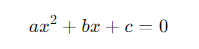
    A quadratic equation is a polynomial equation of the form:ax2+bx+c=0ax^2 + bx + c = 0ax2+bx+c=0

    where aaa, bbb, and ccc are constants, and xxx represents an unknown variable. The highest degree (or exponent) of xxx is 2, which defines it as a quadratic equation.

    • If a=0a = 0a=0, the equation becomes linear.
    • If a≠0a \neq 0a=0, the equation forms a parabola when graphed.

    Solving Quadratic Equations

    There are several methods to solve quadratic equations, each with its advantages depending on the specific equation.

    1. Factoring: Factoring is one of the simplest methods, but it only works for certain equations. You rewrite the quadratic equation in a factorized form:ax2+bx+c=(mx+n)(px+q)=0ax^2 + bx + c = (mx + n)(px + q) = 0ax2+bx+c=(mx+n)(px+q)=0To solve the equation, set each factor to zero and solve for xxx:(mx+n)=0or(px+q)=0(mx + n) = 0 \quad \text{or} \quad (px + q) = 0(mx+n)=0or(px+q)=0Example:x2−5x+6=0⇒(x−2)(x−3)=0x^2 – 5x + 6 = 0 \quad \Rightarrow \quad (x – 2)(x – 3) = 0x2−5x+6=0⇒(x−2)(x−3)=0The solutions are x=2x = 2x=2 and x=3x = 3x=3.
    1. Factoring Quadratics – Khan Academy
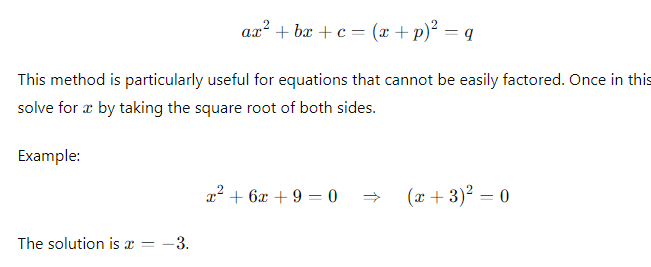
    2. Completing the Square: Completing the square is a method that transforms the quadratic equation into a perfect square trinomial:ax2+bx+c=(x+p)2=qax^2 + bx + c = (x + p)^2 = qax2+bx+c=(x+p)2=qThis method is particularly useful for equations that cannot be easily factored. Once in this form, solve for xxx by taking the square root of both sides.Example:x2+6x+9=0⇒(x+3)2=0x^2 + 6x + 9 = 0 \quad \Rightarrow \quad (x + 3)^2 = 0x2+6x+9=0⇒(x+3)2=0The solution is x=−3x = -3x=−3.

    Completing the Square – Math Is Fun

    1. Quadratic Formula: The quadratic formula is a universal method that works for any quadratic equation:x=−b±b2−4ac2ax = \frac{-b \pm \sqrt{b^2 – 4ac}}{2a}x=2a−b±b2−4ac​​Here, the discriminant (b2−4acb^2 – 4acb2−4ac) determines the nature of the solutions:
      • If b2−4ac>0b^2 – 4ac > 0b2−4ac>0, there are two real solutions.If b2−4ac=0b^2 – 4ac = 0b2−4ac=0, there is one real solution.If b2−4ac<0b^2 – 4ac < 0b2−4ac<0, there are two complex (imaginary) solutions.
      Example:2×2+3x−2=0⇒x=−3±32−4(2)(−2)2(2)2x^2 + 3x – 2 = 0 \quad \Rightarrow \quad x = \frac{-3 \pm \sqrt{3^2 – 4(2)(-2)}}{2(2)}2×2+3x−2=0⇒x=2(2)−3±32−4(2)(−2)​​The solutions are x=−3+254=0.5x = \frac{-3 + \sqrt{25}}{4} = 0.5x=4−3+25​​=0.5 and x=−3−254=−2x = \frac{-3 – \sqrt{25}}{4} = -2x=4−3−25​​=−2.
    1. Quadratic Formula – BBC Bitesize

    The Discriminant

    The discriminant (b2−4acb^2 – 4acb2−4ac) is an important part of the quadratic formula because it tells you how many solutions the equation has, and whether those solutions are real or complex.

    1. Understanding the Discriminant – Varsity Tutors

    Graphing Quadratic Equations

    Quadratic equations are often represented graphically as parabolas. The general shape of a parabola depends on the value of aaa:

    • If a>0a > 0a>0, the parabola opens upwards (U-shaped).
    • If a<0a < 0a<0, the parabola opens downwards (inverted U-shaped).

    Key features of a parabola include:

    • Vertex: The highest or lowest point on the graph.
    • Axis of Symmetry: The vertical line that passes through the vertex.
    • Roots or x-intercepts: The points where the parabola intersects the x-axis (i.e., the solutions of the equation).

    The vertex of a parabola can be found using the formula:xvertex=−b2ax_{\text{vertex}} = \frac{-b}{2a}xvertex​=2a−b​

    Applications of Quadratic Equations

    Quadratic equations are used in a variety of real-world scenarios:

    1. Projectile Motion: The path of a projectile (like a ball being thrown) follows a quadratic equation, where the height of the object is a function of time. Example: The equation h(t)=−4.9t2+vt+h0h(t) = -4.9t^2 + vt + h_0h(t)=−4.9t2+vt+h0​ describes the height of a projectile in terms of time ttt, initial velocity vvv, and initial height h0h_0h0​.
    2. Optimization Problems: Quadratic equations are often used to find maximum or minimum values in optimization problems, such as finding the best price to sell a product or determining the maximum area for a given perimeter.
    3. Area Calculations: Quadratics can be used to calculate areas of geometric shapes when they involve squared dimensions.

    Conclusion

    Quadratic equations are a critical component of IGCSE Mathematics. Mastering the different methods of solving quadratics, understanding the discriminant, and learning how to apply them in real-life situations will help you succeed in math and beyond. Whether through factoring, completing the square, or using the quadratic formula, you’ll have the tools you need to solve any quadratic equation with confidence.

  • Mathematics: Understanding Trigonometry

    Mathematics: Understanding Trigonometry

    Understanding Trigonometry

    Understanding Trigonometry

    Mathematics: Understanding Trigonometry is a crucial topic in the IGCSE Mathematics syllabus that deals with the
    relationships between angles and sides of triangles, particularly right-angled triangles. These relationships form the foundation for understanding various real-world problems, including navigation, architecture, and engineering. In this article, we will cover the basics of trigonometry, including trigonometric ratios, solving triangles, and applying trigonometry to real-life situations.

    What is Trigonometry?

    Trigonometry is the branch of mathematics that studies the relationships between the angles and lengths of triangles. Specifically, it focuses on right-angled triangles, where one angle is 90∘90^\circ90∘. In trigonometry, we explore how the angles of a triangle relate to the lengths of the sides.

    The three main trigonometric functions, or ratios, are:

    • Sine (sin): The ratio of the opposite side to the hypotenuse.
    • Cosine (cos): The ratio of the adjacent side to the hypotenuse.
    • Tangent (tan): The ratio of the opposite side to the adjacent side.

    These ratios allow us to solve for unknown sides or angles in right-angled triangles when some information is already known.

    Trigonometric Ratios

    Mathematics: Understanding Trigonometry

    The three basic trigonometric ratios are fundamental in solving problems related to triangles. Here is how they are defined for a right-angled triangle:

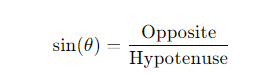
    1. Sine:sin⁡(θ)=OppositeHypotenuse\sin(\theta) = \frac{\text{Opposite}}{\text{Hypotenuse}}sin(θ)=HypotenuseOpposite​The sine of an angle is the ratio between the length of the side opposite the angle and the hypotenuse.
    1. Cosine:cos⁡(θ)=AdjacentHypotenuse\cos(\theta) = \frac{\text{Adjacent}}{\text{Hypotenuse}}cos(θ)=HypotenuseAdjacent​The cosine of an angle is the ratio of the length of the adjacent side to the hypotenuse.
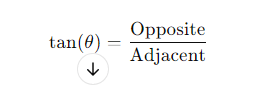
    1. Tangent:tan⁡(θ)=OppositeAdjacent\tan(\theta) = \frac{\text{Opposite}}{\text{Adjacent}}tan(θ)=AdjacentOpposite​The tangent of an angle is the ratio between the side opposite the angle and the side adjacent to it.

    Solving Right-Angled Triangles

    Trigonometry is often used to solve right-angled triangles, where you may be required to find a missing side or angle.

    1. Finding a Side: Suppose you know one angle (other than the right angle) and one side of a right-angled triangle. You can use one of the trigonometric ratios to find a missing side. For example, if you know the angle θ\thetaθ and the length of the hypotenuse, you can find the opposite side using:sin⁡(θ)=OppositeHypotenuse⇒Opposite=sin⁡(θ)×Hypotenuse\sin(\theta) = \frac{\text{Opposite}}{\text{Hypotenuse}} \quad \Rightarrow \quad \text{Opposite} = \sin(\theta) \times \text{Hypotenuse}sin(θ)=HypotenuseOpposite​⇒Opposite=sin(θ)×Hypotenuse
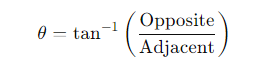
    1. Finding an Angle: To find an unknown angle, you can use the inverse of the trigonometric ratios. For instance, if you know the opposite and adjacent sides, you can find the angle θ\thetaθ using:θ=tan⁡−1(OppositeAdjacent)\theta = \tan^{-1} \left( \frac{\text{Opposite}}{\text{Adjacent}} \right)θ=tan−1(AdjacentOpposite​)
    1. Pythagoras’ Theorem: Another useful tool when solving triangles is Pythagoras’ Theorem, which states that in a right-angled triangle:a2+b2=c2a^2 + b^2 = c^2a2+b2=c2where aaa and bbb are the lengths of the two legs, and ccc is the length of the hypotenuse. This theorem allows you to find the length of one side when the other two sides are known.
    1. Solving Right-Angled Triangles – MathsIsFun

    The Unit Circle and Trigonometric Functions

    Understanding Trigonometry

    Beyond right-angled triangles, trigonometric functions are defined using the unit circle, a circle with a radius of 1 centered at the origin of the coordinate plane. The unit circle helps extend the definition of trigonometric functions to any angle, including those greater than 90∘90^\circ90∘.

    In the unit circle: Understanding Trigonometry

    • The x-coordinate of a point on the circle corresponds to the cosine of the angle.
    • The y-coordinate corresponds to the sine of the angle.
    • The tangent is the ratio of the sine to the cosine at any point on the circle.

    This concept is crucial in advanced trigonometry and has applications in areas like physics and engineering. Understanding Trigonometry

    Applications of Trigonometry in Real Life

    Trigonometry is used in many fields, from architecture to astronomy. Some common real-life applications include: Understanding Trigonometry

    1. Architecture and Engineering: Architects and engineers use trigonometry to calculate angles, lengths, and forces when designing structures such as bridges and buildings. For example, knowing the angles of inclination can help determine the height of a building or the length of a support beam.
    2. Navigation: Pilots and sailors use trigonometry to determine distances and plot courses. By calculating angles based on positions and distances, trigonometry helps in navigation over both land and sea.
    3. Physics and Astronomy: Trigonometry is essential for calculating the trajectories of objects, such as satellites or spacecraft, and for understanding the properties of waves, light, and sound.

    Trigonometric Identities

    Trigonometric identities are equations that are true for all values of the variables involved. These identities are useful in simplifying expressions and solving trigonometric equations. Understanding Trigonometry

    1. Pythagorean Identity:sin⁡2(θ)+cos⁡2(θ)=1\sin^2(\theta) + \cos^2(\theta) = 1sin2(θ)+cos2(θ)=1

    This identity is derived from the unit circle and is one of the most important identities in trigonometry.

    1. Tangent Identity:tan⁡(θ)=sin⁡(θ)cos⁡(θ)\tan(\theta) = \frac{\sin(\theta)}{\cos(\theta)}tan(θ)=cos(θ)sin(θ)​
    1. Reciprocal Identities:
    1. Trigonometric Identities – Math Open Reference

    Conclusion Understanding Trigonometry

    Trigonometry is a versatile and essential branch of mathematics that extends beyond the classroom and into real-world applications. By mastering the trigonometric ratios, solving triangles, and understanding the unit circle, students gain the tools needed for advanced mathematical studies and various practical applications in science, engineering, and architecture.

  • IGCSE Chemistry: The Chemistry of Acids, Bases, and Salts

    IGCSE Chemistry: The Chemistry of Acids, Bases, and Salts

    , bases, and salts are fundamental concepts in Chemistry and play a crucial role in various reactions, processes, and everyday applications. Understanding the properties, reactions, and uses of acids and bases, as well as how salts are formed, is a core component of the IGCSE Chemistry syllabus. This article will provide a detailed overview of these topics, exploring definitions, reactions, and real-world applications.

    What Are Acids and Bases?

    In Chemistry, and bases are substances that can donate or accept protons (H+^++ ions) in reactions. They are often classified based on their ability to either release hydrogen ions (for ) or hydroxide ions (for bases) when dissolved in water.

    1. : An acid is any substance that donates H+^++ ions when dissolved in water. Common examples include hydrochloric acid (HCl), sulfuric acid (H2_22​SO4_44​), and nitric acid (HNO3_33​). have a pH lower than 7, turn blue litmus paper red, and react with bases to form salts and water.
    2. Bases: A base is any substance that accepts H+^++ ions or releases hydroxide ions (OH−^-−) when dissolved in water. Sodium hydroxide (NaOH) and potassium hydroxide (KOH) are common bases. Bases have a pH greater than 7, turn red litmus paper blue, and react with to neutralize them.
    3. Alkalis: Alkalis are a specific type of base that is soluble in water and releases hydroxide ions (OH−^-−) in solution. Examples include sodium hydroxide and calcium hydroxide.

    Properties of Acids and Bases

    Understanding the properties of acids and bases helps explain their behavior in reactions and applications.

    1. Acid Properties:
      • Taste: have a sour taste (e.g., lemon juice contains citric acid).
      • Reaction with Metals: react with metals like zinc or magnesium to produce hydrogen gas.
      • Reaction with Carbonates: react with carbonates to produce carbon dioxide, water, and salt.
    2. Base Properties:

    The pH Scale

    The pH scale is used to measure the acidity or alkalinity of a solution. The scale ranges from 0 to 14, where:

    • pH < 7: Acidic solutions (e.g., lemon juice, vinegar)
    • pH = 7: Neutral solutions (e.g., pure water)
    • pH > 7: Alkaline solutions (e.g., soap solution)

    A universal indicator or pH paper can be used to determine the pH of a substance, changing color according to the pH value.

    Neutralization Reactions

    A neutralization reaction occurs when an acid and a base react to form water and a salt. This type of reaction is fundamental to many chemical processes, including digestion, industrial waste treatment, and agriculture.

    The general equation for a neutralization reaction is:Acid+Base→Salt+Water\text{Acid} + \text{Base} \rightarrow \text{Salt} + \text{Water}Acid+Base→Salt+Water

    For example, when hydrochloric acid reacts with sodium hydroxide, the products are sodium chloride (a salt) and water:HCl+NaOH→NaCl+H2OHCl + NaOH \rightarrow NaCl + H_2OHCl+NaOH→NaCl+H2​O

    Salts and Their Formation

    Salts are ionic compounds formed from the neutralization of an acid by a base. They consist of a positive ion (from the base) and a negative ion (from the acid).

    1. Common Types of Salts:
      • Sodium chloride (NaCl): Formed from hydrochloric acid and sodium hydroxide, it’s the most common salt, used in food seasoning.
      • Calcium carbonate (CaCO3_33​): Found in limestone and chalk, it is used in construction and manufacturing.
      • Ammonium sulfate (NH4)2SO4(NH_4)_2SO_4(NH4​)2​SO4​: Used as a fertilizer, formed from sulfuric acid and ammonia.
    2. Uses of Salts:
      • In Food: Salts like sodium chloride are essential in food preservation and flavoring.
      • In Industry: Salts like ammonium nitrate are used in fertilizers, while others are used in manufacturing and cleaning products.
      • Types and Uses of Salts – BBC Bitesize

    Applications of Acids and Bases

    1. In Industry:
      • Acids such as sulfuric acid are used in the manufacture of fertilizers, batteries, and detergents.
      • Bases like sodium hydroxide are used in soap production, paper manufacturing, and chemical synthesis.
    2. In Daily Life:

    Conclusion

    Understanding the chemistry of acids, bases, and salts is vital for grasping how many reactions occur in both industrial and biological systems. From the neutralization of stomach acid to the production of fertilizers, acids and bases play essential roles in daily life. The IGCSE syllabus ensures students are equipped with the knowledge to apply these concepts in practical and real-world contexts.

  • Advanced Concepts in IGCSE Organic Chemistry

    Advanced Concepts in IGCSE Organic Chemistry

    Advanced Concepts in IGCSE Organic Chemistry, as covered in the IGCSE syllabus, not only lays the foundation for understanding carbon-based compounds but also prepares students for more advanced chemistry concepts. As students progress, they encounter more intricate aspects of Organic Chemistry, which delve into the complexities of bonding, reactions, and the synthesis of larger molecules. This article explores advanced topics such as isomerism, polymerization, organic biochemistry, and the environmental impact of organic substances.

    Isomerism in Organic Chemistry

    “Advanced Concepts in IGCSE Organic Chemistry”

    Advanced Concepts in IGCSE Organic Chemistry Isomerism is a concept where compounds with the same molecular formula have different structural arrangements, resulting in different chemical and physical properties.

    1. Structural Isomerism: In this type, the atoms are arranged differently. For example, butane (C4H10C_4H_{10}C4​H10​) has two isomers: n-butane and isobutane, each having a different structure.
    2. Geometrical (Cis-Trans) Isomerism: Commonly seen in alkenes, geometrical isomerism arises from the restricted rotation around the carbon-carbon double bond. For example, in but-2-ene, the two methyl groups can either be on the same side (cis) or opposite sides (trans).
    Advanced Concepts in IGCSE Organic Chemistry

    Advanced Concepts in IGCSE Organic Chemistry Polymerization: The Chemistry of Plastics

    Polymerization is essential in industrial applications, particularly for creating plastics.

    1. Addition Polymerization: In this reaction, alkene monomers join to form long-chain polymers. Ethene (C2H4C_2H_4C2​H4​) forms polyethylene, a common plastic. Similarly, propene (C3H6C_3H_6C3​H6​) produces polypropylene.
    2. Uses of Polymers: Polymers are vital in daily life, from packaging to textiles. However, the rise in plastic waste has led to environmental issues, highlighting the need for biodegradable polymers.

    Organic Chemistry in Biochemistry

    Organic Chemistry forms the basis for biochemistry, which studies the organic molecules essential for life.

    1. Carbohydrates: Organic compounds like glucose are essential for energy. More complex carbohydrates, such as starch and cellulose, are made up of glucose monomers.
    2. Proteins: Proteins consist of amino acids, which include amine and carboxyl groups. Proteins function in enzymes, hormones, and cell structure.
    3. Lipids: Lipids are long hydrocarbon chains used for energy storage, insulation, and cell membranes.

    Environmental Impact of Organic Compounds

    While organic compounds are essential, they can also negatively impact the environment.

    1. Greenhouse Gases: Methane (CH4CH_4CH4​), an organic compound, is a potent greenhouse gas that contributes to climate change.
    2. Plastic Pollution: The widespread use of non-biodegradable plastics has created severe pollution issues, affecting marine life and ecosystems.
    3. Organic Pollutants: Organic pollutants, such as pesticides, can accumulate in ecosystems and affect the food chain.

    The Role of Organic Chemistry in Medicine

    Organic Chemistry plays a crucial role in drug design and synthesis, impacting healthcare worldwide. Advanced Concepts in IGCSE Organic Chemistry

    1. Synthesis of Medicines: Many medicines are organic compounds. Aspirin, for example, is synthesized by esterifying salicylic acid.
    2. Antibiotics: Organic compounds like penicillin revolutionized medicine by providing effective treatments for bacterial infections.
    3. Vitamins and Hormones: Organic compounds also include vital substances like vitamins and hormones, which regulate various bodily functions.

    Conclusion Advanced Concepts in IGCSE Organic Chemistry

    Organic Chemistry, especially as studied in the IGCSE syllabus, is an essential field that influences multiple aspects of life and industry. From understanding hydrocarbons and polymers to exploring the environmental challenges posed by organic compounds, students learn how chemistry shapes the world. Mastering these concepts opens up possibilities for tackling pressing global issues, such as climate change and plastic pollution, while also contributing to innovations in medicine and biochemistry. Advanced Concepts in IGCSE Organic Chemistry

    By studying Organic Chemistry, students not only prepare for exams but also develop a deeper appreciation for the molecular mechanisms that govern the world around us. Advanced Concepts in IGCSE Organic Chemistry


    These external links provide further resources and reading materials for students to dive deeper into the various topics covered in this article. Advanced Concepts in IGCSE Organic Chemistry